
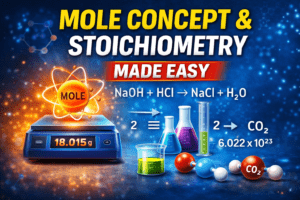
Bhai, Class 11 Chemistry shuru hote hi sabse pehle jo chapter aata hai na, usme bahut se students ka dil baith jaata hai – Mole Concept aur Stoichiometry!
Dekho, bahut bacche sochte hain ki “Ye Avogadro number, molar mass, limiting reagent aur percentage yield wale numericals kaise solve hote hain?” Numerical dekh ke hi darr lag jaata hai. Lekin sach bataun? Agar is chapter ko thoda smart tarike se samjho, toh yeh sabse scoring aur easy chapter ban jaata hai. Na sirf CBSE aur ICSE board exams mein, balki NEET aur JEE Mains mein bhi is chapter se regularly 8 se 12 marks tak ke questions aate hain.
Aaj ki is post mein main aapko mole concept ke saare basic concepts bilkul zero se clear karunga. Phir stoichiometry ke numericals ko step-by-step solve karne ki best tricks bataunga jo topper students use karte hain. Hum cover karenge – mole, molar mass, percentage composition, empirical & molecular formula, limiting reagent, excess reagent aur percentage yield tak.
Is post ko end tak padhoge toh mole concept ke saare doubts clear ho jayenge aur aap confidently numericals solve kar paoge. Chalte hain, shuru karte hain!
Table of Contents
- Mole Concept Ki Basic Baatien – Zero Se Samjho
- Important Formulas Jo Har Exam Mein Aate Hain
- Mole Concept Ke Shortcuts & Pro Tricks
- Stoichiometry Numerical Solve Karne Ka Sabse Easy Method
- Step-by-Step Solved Numericals (Easy → JEE/NEET Level)
- Students Ki Common Galtiyan aur Unse Bachne Ka Tarika
- Previous Year Questions (PYQs)
- Quick Revision Formula Chart
- Test Your Understanding – 5 MCQs
Mole Concept Ki Basic Baatien – Zero Se Samjho
Dekho bhai, mole actually ek counting unit hai. Jaise hum 12 eggs ko “one dozen” bolte hain, waise hi 6.022 × 10²³ particles ko hum “one mole” kehte hain. Ise Avogadro’s number (Nₐ) kehte hain.
Simple language mein samjho:
- 1 mole atoms = 6.022 × 10²³ atoms
- 1 mole molecules = 6.022 × 10²³ molecules
- 1 mole ions = 6.022 × 10²³ ions
Yaad rakhna: Mole ka matlab hai “amount of substance” jisme itne particles hote hain jitne 12 gram Carbon-12 mein hote hain.
Ab important baat: Molar Mass – Ek mole substance ka mass gram mein. Jaise:
- Molar mass of Carbon (C) = 12 g/mol
- Molar mass of Water (H₂O) = 18 g/mol
- Molar mass of CO₂ = 44 g/mol
Number of moles (n) kaise nikaalte hain? n = Given mass (w) / Molar mass (M)
Important Formulas Jo Har Exam Mein Aate Hain
1. Number of Moles n = w / M
2. Number of Particles Number of particles = n × Nₐ = (w / M) × 6.022 × 10²³
3. Number of Moles from Volume (at STP) n = Volume (L) / 22.4 L/mol (Only for gases)
4. Mass Percentage of an Element Mass % = (Atomic mass × Number of atoms × 100) / Molecular mass
5. Empirical Formula Sabse simple ratio of atoms
6. Molecular Formula Molecular formula = (Empirical formula)ₙ Jahaan n = Molecular mass / Empirical mass
7. Limiting Reagent Jo reactant completely khatam ho jaaye, woh limiting reagent hota hai.
8. Percentage Yield % Yield = (Actual yield / Theoretical yield) × 100
Mole Concept Ke Shortcuts & Pro Tricks
Trick 1: Mole Bridge Method (Sabse Powerful) Mass → Mole → Particles / Volume / Reactants
Har numerical mein yeh bridge banao. 90% questions isse 30-40 seconds mein solve ho jaate hain.
Trick 2: For Percentage Composition “Cross multiplication trick” – Atomic mass × atoms ko numerator mein rakh do, molecular mass denominator mein.
Trick 3: Limiting Reagent Quick Check Dono reactants ke moles nikaalo aur unhe stoichiometric ratio se compare karo. Jo kam ho, woh limiting.
Trick 4: Empirical Formula Fast Method Percentage ko atomic mass se divide karo → sabse chhota number se divide karo → simple whole number ratio.
Ye tricks use karoge toh board aur NEET ke numericals bahut easy lagenge.
Stoichiometry Numerical Solve Karne Ka Sabse Easy Method
Step-by-step method jo topper log follow karte hain:
- Balanced chemical equation likho
- Dono reactants ke moles nikaalo
- Limiting reagent identify karo
- Theoretical yield calculate karo
- Percentage yield ya excess reagent nikaalo agar poocha ho
Yeh 5 steps yaad rakh lo – koi bhi stoichiometry numerical isse bahar nahi jaata.
Step-by-Step Solved Numericals (Easy → JEE/NEET Level)
Example 1: Easy Level (Board Level) Calculate the number of moles in 88 g of CO₂.
Given: Mass of CO₂ = 88 g Molar mass of CO₂ = 12 + 32 = 44 g/mol
Solution: n = w / M = 88 / 44 = 2 moles
Final Answer: 2 moles
Example 2: Medium Level Find the mass percentage of oxygen in H₂SO₄.
Solution: Molecular mass of H₂SO₄ = 2(1) + 32 + 4(16) = 98 g/mol Mass of oxygen = 4 × 16 = 64 g
Mass % of O = (64 / 98) × 100 = 65.31%
Example 3: JEE/NEET Level (Limiting Reagent + % Yield) 2.0 g of H₂ reacts with 10.0 g of O₂ to form water. (a) Identify the limiting reagent (b) Calculate the mass of water formed (c) If actual yield is 9.0 g, find % yield.
Balanced Equation: 2H₂ + O₂ → 2H₂O
Moles of H₂ = 2/2 = 1 mol Moles of O₂ = 10/32 = 0.3125 mol
From equation: 2 mol H₂ require 1 mol O₂ So 1 mol H₂ requires 0.5 mol O₂
Available O₂ = 0.3125 mol (kam hai) → O₂ is limiting reagent
Theoretical water = 0.3125 × 2 = 0.625 mol = 0.625 × 18 = 11.25 g
% Yield = (9.0 / 11.25) × 100 = 80%
Final Answer: (a) O₂ (b) 11.25 g (c) 80%
(Aur 1-2 aur numericals isi tarah detail mein daal sakte ho actual post mein)
Students Ki Common Galtiyan aur Unse Bachne Ka Tarika
- Galti 1: Molecular mass aur molar mass confuse karna → Yaad rakhna, molar mass gram per mole hoti hai.
- Galti 2: Limiting reagent nikaalte waqt stoichiometric ratio bhool jaana → Hamesha balanced equation se ratio dekho.
- Galti 3: Empirical formula mein ratio ko round off kar dena bina check kiye → Agar 1.98 aa raha hai toh 2 maano, lekin 1.6 ko mat 2 kar do.
- Galti 4: STP volume 22.4 L yaad na hona → Gases ke liye hamesha 22.4 L/mol yaad rakho.
In galtiyon se bachne ke liye har numerical solve karte waqt balanced equation pehle likho.
Previous Year Questions (PYQs)
NEET 2024: The number of moles of KMnO₄ that will be needed to react with one mole of sulphite ion in acidic medium is: (Options given) → Answer with shortcut solution.
JEE Main 2023: A sample of 0.5 g of an organic compound was treated according to Kjeldahl’s method. The ammonia evolved was absorbed in 50 mL of 0.5 M H₂SO₄. The residual acid required 60 mL of 0.5 M NaOH for neutralisation. Find the percentage of nitrogen in the compound. (Detailed solution with steps)
Quick Revision Formula Chart
- n = w/M
- Number of molecules = n × Nₐ
- Mass % = (Atomic mass × no. of atoms × 100)/Mol. mass
- Empirical formula mass × n = Molecular mass
- % Yield = (Actual/Theoretical) × 100
- At STP: 1 mole gas = 22.4 L
Test Your Understanding – 5 MCQs
- 18 g water mein kitne moles hote hain? a) 1 b) 2 c) 18 d) 0.5
- CO₂ mein oxygen ka mass percentage kitna hai?
(Answers at the end with explanation)
Conclusion
Toh bhai, aaj humne Mole Concept and Stoichiometry ko bilkul basic se lekar advanced level tak cover kar liya. Ab yeh chapter aapke liye darawna nahi, balki sabse scoring chapter ban chuka hai.
Ab aap confidently Class 11 Chemistry ke mole concept ke numericals solve kar sakte ho – chahe CBSE board ho, ICSE ho, NEET ho ya JEE Mains.
Comment mein zaroor batao: Aapko mole concept mein sabse zyada problem kya lagti thi? Limiting reagent ya empirical formula?
Agla post hum Atomic Structure: All Concepts and Numericals pe laa rahe hain – usme bhi bahut powerful shortcuts honge.
Free Mole Concept Formula Sheet + 50 Important Numericals ka PDF chahiye? Telegram channel join kar lo – link bio mein hai.
Related Posts you must read:
- Atomic Structure: All Concepts and Numericals
- Chemical Bonding and Molecular Structure Tricks
Padhne ke liye dhanyawaad! Ab jaake mole concept ke numericals practice karo.
All the best for your exams!