
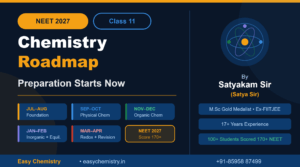
NEET 2027 Preparation Starts Now: A Complete Chemistry Roadmap for Class 11
By Satyakam Sir (Satya Sir) | Easy Chemistry | July 2026
Most Class 11 students make the same mistake. They think NEET preparation begins in Class 12.
By the time they realise it does not — the syllabus is already half done, the concepts are already shaky, and the time to fix them is already shrinking. They spend Class 12 trying to relearn what they should have understood in Class 11, while simultaneously managing board exams, mock tests, and exam pressure.
Do not let that be your story.
If you are in Class 11 right now — whether you just started or you are already a few months in — this is the most important thing you will read about NEET 2027 preparation: the students who crack NEET with 680+ marks did not start preparing in Class 12. They started in Class 11. And they started with chemistry.
This blog is your complete chemistry roadmap for Class 11 — chapter by chapter, month by month — written by Satyakam Sir (Satya Sir) of Easy Chemistry, with 17 years of NEET teaching experience behind every word of it.
Why Chemistry Is the Subject That Decides Your NEET Rank
NEET has three subjects — Physics, Biology, and Chemistry. Each carries 180 marks. But they are not equal in terms of how much a great teacher changes your score.
Biology rewards consistent reading and revision. Physics rewards problem-solving practice. But chemistry sits at a unique intersection — it demands conceptual logic, careful memorisation, and fast application all at once. That combination is exactly why most students either love chemistry or fear it — and very little in between.
Here is what the data shows year after year: students who score 160+ in NEET Chemistry almost always crack NEET. Students who score below 130 in chemistry almost always do not — even if Physics and Biology are strong.
Chemistry is not just one of the three subjects. For NEET 2027, chemistry is the subject that will determine which side of the cutoff you land on.
Understanding the Class 11 Chemistry Syllabus for NEET
Before the roadmap, let us be clear about what Class 11 Chemistry for NEET actually covers. It is divided into three branches:
Physical Chemistry — the mathematical and conceptual core of chemistry. Topics like atomic structure, thermodynamics, equilibrium, and electrochemistry fall here. These topics require logical thinking and numerical practice.
Organic Chemistry — the logic-based branch. Class 11 organic starts with basic concepts and hydrocarbons. The foundations you build here directly determine how well you handle Class 12 organic, which is far more complex.
Inorganic Chemistry — the factual branch. s-block and p-block elements, periodic trends, and hydrogen form the Class 11 inorganic portion. Students either memorise it randomly — and forget — or learn it systematically and score consistently.
A complete NEET 2027 preparation plan for Class 11 must address all three branches, in the right order, with the right depth.
Month-by-Month Chemistry Roadmap for Class 11 — NEET 2027
📅 July – August 2026 | Build the Foundation
These two months are the most important of your entire Class 11 year. What you understand here will either support everything that comes after — or undermine it.
Focus Topics:
Some Basic Concepts of Chemistry (Mole Concept) This is the starting point of all of NEET Chemistry. Mole concept is not just a topic — it is the language chemistry speaks. If you are weak here, every numerical in Physical Chemistry will feel impossible. Spend real time on this. Do not rush it.
Key concepts to master: mole, Avogadro’s number, molarity, molality, mole fraction, limiting reagent, percentage composition, empirical and molecular formula
Structure of Atom Quantum mechanical model, Bohr’s model, quantum numbers, electronic configuration, Aufbau principle, Hund’s rule, Pauli exclusion principle. This chapter is NEET’s favourite for both direct and application questions.
Classification of Elements and Periodicity in Properties Do not memorise trends — understand them. Why does atomic radius decrease across a period? Why does ionisation energy increase? When you understand the logic, you remember it permanently.
Satyakam Sir’s Tip for July–August: Every evening, revise what you studied in the morning. Even ten minutes of revision doubles retention. Class 11 students who build this habit in July carry it all the way to NEET 2027 — and it shows in their scores.
📅 September – October 2026 | Go Deeper Into Physical Chemistry
By September, your foundation chapters should be solid. Now you move into the most numerically demanding part of Class 11 Chemistry.
Focus Topics:
Chemical Bonding and Molecular Structure VSEPR theory, hybridisation, bond polarity, dipole moment, molecular orbital theory — this chapter connects atomic structure (what you studied in August) to the behaviour of molecules. It requires visualisation. Draw every structure. Do not just read about it.
States of Matter Gas laws, kinetic molecular theory, real gases, van der Waals equation. This chapter has a predictable set of numerical types — master them all. NEET frequently repeats similar question patterns here.
Thermodynamics The chapter most students fear and most toppers love. First law, enthalpy, Hess’s law, entropy, Gibbs free energy. The logic here is airtight — everything connects. A good teacher makes this chapter beautiful. A bad explanation makes it a nightmare. Invest in understanding it correctly the first time.
Satyakam Sir’s Tip for September–October: Thermodynamics is too important to learn from a bad source. If your school teacher is not explaining it clearly — find a better explanation immediately. Do not wait until Class 12 to realise your thermodynamics is weak. By then, it is too late to rebuild comfortably.
📅 November – December 2026 | Organic Chemistry — Build the Logic
Most students postpone organic chemistry. They find the naming confusing, the reactions overwhelming, and the mechanisms intimidating. That postponement is one of the most expensive mistakes a NEET aspirant can make.
Start organic chemistry in November of Class 11. Build it right from the beginning. By the time Class 12 organic arrives — which is harder and more varied — you will have a foundation that makes it manageable.
Focus Topics:
Some Basic Principles and Techniques of Organic Chemistry IUPAC nomenclature, isomerism, inductive effect, resonance, hyperconjugation, types of reactions (addition, substitution, elimination). This is the grammar of organic chemistry. Every mechanism, every reaction, every Class 12 organic topic — all of it is written in this language.
Do not memorise naming rules. Understand the system. Once you understand why a compound is named the way it is, you can name any compound NEET throws at you.
Hydrocarbons Alkanes, alkenes, alkynes, aromatic compounds — reactions, preparation, properties. Learn reactions through mechanisms, not by listing them. Ask yourself: why does this reaction happen? What is the electron movement? What drives the product formation?
Satyakam Sir’s Tip for November–December: Write out organic mechanisms by hand. Every single one. Your hand remembers what your eyes skim over. A mechanism written ten times is a mechanism remembered in the exam hall.
📅 January – February 2027 | Inorganic Chemistry + Equilibrium
January is the time to build your inorganic base and begin one of Physical Chemistry’s most important chapters for NEET.
Focus Topics:
Hydrogen Properties, preparation, uses of hydrogen and its compounds — water, hydrogen peroxide. Not the heaviest chapter but frequently tested. Do not skip it.
s-Block Elements — Alkali and Alkaline Earth Metals Group 1 and Group 2 elements — properties, compounds, anomalous behaviour of lithium and beryllium. NEET loves this chapter. Learn trends across the group, not random facts.
p-Block Elements (Class 11 portion — Groups 13 and 14) Boron family and carbon family. Properties, allotropes, important compounds. Again — understand trends. Why does carbon form more covalent compounds than silicon? Why is diamond hard and graphite soft? Logic-based learning sticks. Rote learning evaporates under pressure.
Chemical Equilibrium Le Chatelier’s principle, Kc, Kp, Kx relationships, degree of dissociation, factors affecting equilibrium. This chapter bridges Class 11 Physical Chemistry into the ionic equilibrium chapter that follows in Class 12. Get it right here and Class 12 becomes significantly easier.
Satyakam Sir’s Tip for January–February: Inorganic chemistry is best revised through comparison tables. Make your own table comparing Group 1 vs Group 2 properties. Make a table comparing allotropes of carbon. The act of making the table is revision — and the table itself becomes a revision tool for NEET 2027.
📅 March – April 2027 | Redox, Environmental, and Revision
Focus Topics:
Redox Reactions Oxidation state, balancing redox reactions by half-reaction method and ion-electron method. This chapter feeds directly into Class 12 electrochemistry — one of NEET’s highest-weightage Physical Chemistry chapters. Build it properly now.
Environmental Chemistry Do not underestimate this chapter. NEET consistently asks 2–3 direct questions from environmental chemistry — greenhouse gases, acid rain, ozone depletion, smog, water pollutants. One week of focused study here can give you 8–12 marks in NEET 2027.
Full Class 11 Revision By April, all Class 11 chemistry topics should be covered. Spend the last two weeks doing a structured revision — topic by topic, using your notes and previous year NEET questions from Class 11 chapters.
Satyakam Sir’s Tip for March–April: Solve at least 20 NEET Previous Year Questions (PYQs) from each Class 11 chapter. Not to memorise the answers — but to understand what NEET actually asks from each topic. PYQs are the clearest possible signal of what matters and what does not.
NEET 2027 Chemistry Chapter-Wise Weightage — Class 11
| Chapter | NEET Weightage | Priority |
|---|---|---|
| Some Basic Concepts (Mole Concept) | High | 🔴 Must Master |
| Structure of Atom | High | 🔴 Must Master |
| Chemical Bonding | Very High | 🔴 Must Master |
| Thermodynamics | Very High | 🔴 Must Master |
| Chemical Equilibrium | Very High | 🔴 Must Master |
| Hydrocarbons | High | 🔴 Must Master |
| Basic Organic Chemistry | Very High | 🔴 Must Master |
| s-Block Elements | High | 🟠 Important |
| p-Block (Class 11) | Medium-High | 🟠 Important |
| Redox Reactions | High | 🟠 Important |
| States of Matter | Medium | 🟡 Cover Well |
| Periodic Table & Periodicity | Medium | 🟡 Cover Well |
| Hydrogen | Low-Medium | 🟢 Don’t Skip |
| Environmental Chemistry | Low-Medium | 🟢 Don’t Skip |
5 Habits That Separate NEET 2027 Toppers from Everyone Else
1. They revise the same day they study Reading a chapter once is not learning it. Reading it and then writing the key points from memory thirty minutes later — that is learning it. Build same-day revision as a non-negotiable daily habit.
2. They solve NEET PYQs from day one Previous year questions are not just revision tools. They are a map of what NEET values. A student who solves Class 11 PYQs while studying Class 11 knows exactly what level of depth each chapter requires. Start this in July 2026.
3. They clear doubts the same day A doubt that survives overnight becomes a gap. A gap that survives a week becomes a weak area. A weak area that survives a month becomes a problem in the exam. Clear every doubt the same day, every single time.
4. They do not change teachers in the middle of the year Every teacher has a system. Jumping between YouTube channels, tutors, and coaching institutes means picking up five different systems and mastering none of them. Choose your chemistry teacher carefully — then trust the process.
5. They treat Class 11 as seriously as Class 12 This is the biggest differentiator. Students who give Class 11 chemistry 80% of their Class 12 effort will almost always outscore students who coasted through Class 11 and tried to fix everything later.
Common Mistakes Class 11 Students Make — And How to Avoid Them
Skipping Mole Concept because it feels like math, not chemistry. Mole concept is the gateway to all Physical Chemistry numericals. If your mole concept is weak, your thermodynamics, equilibrium, and electrochemistry will all be weak too.
Memorising organic reactions without understanding mechanisms. You can memorise 50 reactions and still fail NEET organic. Or you can understand 10 mechanisms deeply and answer any variation NEET asks. Choose mechanisms.
Treating inorganic as a last-minute topic. Inorganic chemistry covers nearly 30–35% of NEET chemistry. Students who leave it for the last month of preparation almost never cover it properly.
Waiting for Class 12 to “get serious.” Class 12 is too late to build Class 11 foundations. The syllabus doubles, board exams arrive, and there is simply no time to rebuild what should have been built in Class 11.
Studying without a plan. Studying whatever feels easy today, skipping what feels hard, and hoping it all comes together before NEET — this is the most common preparation pattern and the most common reason for disappointing results.
Why Satyakam Sir’s Class 11 Batch at Easy Chemistry Is Different
At Easy Chemistry, Class 11 students do not just cover the syllabus. They build a chemistry foundation that is designed specifically to carry them through Class 12, boards, and NEET 2027 without needing to restart or relearn anything.
Satyakam Sir’s Class 11 batch follows exactly the roadmap laid out in this blog — chapter by chapter, with the right depth, the right pace, and the right emphasis on what NEET actually tests. Every class integrates board preparation and competitive exam preparation simultaneously, so students are never sacrificing one for the other.
Daily doubt clearing. Topic-wise tests. PYQ practice from day one. Small, focused batches where every student is known by name and tracked by progress.
This is what 17 years of NEET teaching looks like when it is applied to Class 11.
Your NEET 2027 Chemistry Journey Starts Today
NEET 2027 is approximately one year away for a current Class 11 student. That sounds like a long time. It is not.
Twelve months of focused, well-guided Class 11 chemistry preparation is exactly enough time to build the foundation that separates NEET toppers from students who almost made it.
The students who will score 170+ in NEET 2027 Chemistry are already studying. Some of them are already in Satyakam Sir’s class at Easy Chemistry.
The question is whether you will be joining them — or watching their results next year and wishing you had started sooner.