
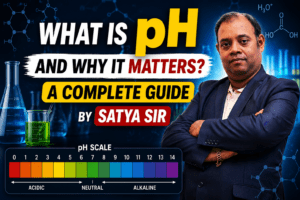
You have seen it on shampoo bottles, swimming pool signs, and soil testing kits. Your chemistry teacher has written it on the board more times than you can count. But if someone asked you right now — what exactly is pH, and why does it matter? — would you have a clear, confident answer?
Most students know pH has something to do with acids and bases. Fewer can explain it properly. And almost none can connect it to real life in a way that makes the concept stick permanently.
That changes today. By the end of this blog, you will understand pH completely — what it means, how it works, why it matters in chemistry and in life, and exactly how it appears in your NEET and JEE exams.
What Is pH? The Simple Definition
pH stands for “potential of Hydrogen” — or more precisely, the power of Hydrogen. It is a scale used to measure how acidic or basic (alkaline) a solution is, based on the concentration of hydrogen ions (H⁺) present in it.
The pH scale runs from 0 to 14.
- pH below 7 → Acidic solution (more H⁺ ions)
- pH equal to 7 → Neutral solution (pure water at 25°C)
- pH above 7 → Basic or alkaline solution (fewer H⁺ ions)
That is the textbook definition. But to truly understand it, we need to go one level deeper.
The Science Behind pH — What Does It Actually Measure?
When any substance dissolves in water, it may release hydrogen ions (H⁺) or hydroxide ions (OH⁻).
- Acids release H⁺ ions — they increase the hydrogen ion concentration in solution
- Bases release OH⁻ ions — they decrease the hydrogen ion concentration in solution
The concentration of H⁺ ions in a solution is written as [H⁺] and measured in moles per litre (mol/L).
Now here is the clever part. The actual concentrations involved in chemistry are extremely small numbers — things like 0.00001 mol/L. Working with numbers like that in equations is messy and error-prone. So the Danish chemist Søren Peder Lauritz Sørensen developed the pH scale in 1909 to make these numbers manageable.
The mathematical formula is:
pH = −log₁₀[H⁺]
In simple words — pH is the negative logarithm of the hydrogen ion concentration.
Why Negative? Why Logarithm?
The logarithm converts very small numbers into a simple, workable scale. And the negative sign flips the relationship so that higher acidity (higher H⁺ concentration) gives a lower pH number — which matches our intuition about acidic things being “low” on the scale.
Example:
- Pure water has [H⁺] = 1 × 10⁻⁷ mol/L
- pH = −log(10⁻⁷) = 7 → Neutral ✓
- Hydrochloric acid (HCl) 0.1 mol/L has [H⁺] = 0.1 = 10⁻¹ mol/L
- pH = −log(10⁻¹) = 1 → Strongly acidic ✓
The pH Scale — A Full Picture
| pH Value | Solution Type | Example |
|---|---|---|
| 0 | Strongly Acidic | Battery acid (H₂SO₄ concentrated) |
| 1 | Strongly Acidic | Stomach acid (HCl) |
| 2 | Acidic | Lemon juice |
| 3 | Acidic | Vinegar, cola drinks |
| 4 | Weakly Acidic | Tomato juice |
| 5 | Weakly Acidic | Black coffee, acid rain |
| 6 | Weakly Acidic | Urine, milk |
| 7 | Neutral | Pure water (at 25°C) |
| 8 | Weakly Basic | Seawater, baking soda solution |
| 9 | Basic | Toothpaste |
| 10 | Basic | Antacid tablets |
| 11 | Strongly Basic | Ammonia solution |
| 12 | Strongly Basic | Soap, lime water |
| 13–14 | Very Strongly Basic | Bleach, drain cleaner (NaOH) |
The Relationship Between pH and pOH
In any aqueous solution at 25°C, the product of hydrogen ion and hydroxide ion concentrations is always constant:
[H⁺] × [OH⁻] = Kw = 1 × 10⁻¹⁴
Taking the negative logarithm of both sides:
pH + pOH = 14
This is one of the most important relationships in acid-base chemistry. It means:
- If pH = 3 → pOH = 11 → strongly acidic
- If pH = 11 → pOH = 3 → strongly basic
- If pH = 7 → pOH = 7 → neutral
This relationship is heavily tested in both NEET and JEE. Know it. Remember it.
Strong Acids, Weak Acids, and pH — Understanding the Difference
Not all acids give the same pH at the same concentration. This is where the concept of strong vs weak acids becomes crucial.
Strong Acids — Complete Ionisation
Strong acids like HCl, HNO₃, H₂SO₄, HClO₄ dissociate completely in water:
HCl → H⁺ + Cl⁻ (100% dissociation)
So for 0.01 mol/L HCl: [H⁺] = 0.01 = 10⁻² mol/L pH = −log(10⁻²) = 2
Weak Acids — Partial Ionisation
Weak acids like CH₃COOH (acetic acid), H₂CO₃, HF only partially dissociate:
CH₃COOH ⇌ CH₃COO⁻ + H⁺ (partial dissociation)
So even at 0.01 mol/L, the actual [H⁺] is much lower — giving a higher (less acidic) pH than a strong acid at the same concentration.
This is why vinegar (acetic acid, weak acid) has a pH around 3–4, while hydrochloric acid at the same concentration would have a pH of 2.
The degree of ionisation of a weak acid is described by its Ka value (acid dissociation constant) — a concept directly tested in JEE and NEET.
pH of Common Substances in Daily Life
Understanding pH becomes much more memorable when you connect it to things you encounter every day.
Your Stomach — pH 1 to 2
Stomach acid (hydrochloric acid) is one of the strongest acid environments in nature. A pH of 1–2 is necessary to denature proteins and kill harmful bacteria in food. When this acid rises into the oesophagus, it causes acidity — and antacids (basic substances, pH 8–10) are used to neutralise it.
Your Blood — pH 7.35 to 7.45
Human blood is maintained at a slightly basic pH between 7.35 and 7.45. This narrow range is critical for life. If blood pH drops below 7.35, a dangerous condition called acidosis occurs. If it rises above 7.45, alkalosis sets in. Your body uses buffer systems (carbonate, phosphate, and protein buffers) to maintain this balance constantly.
Rain Water — pH Around 5.6
Normal rainwater is slightly acidic (pH ~5.6) because atmospheric CO₂ dissolves in it to form carbonic acid (H₂CO₃). Acid rain, caused by industrial pollution releasing SO₂ and NOₓ, can have a pH as low as 4 — damaging buildings, ecosystems, and water bodies.
Soil — pH 6 to 7 for Most Crops
Farmers test soil pH because it determines which nutrients are available to plants. Most crops grow best in slightly acidic to neutral soil. If soil is too acidic, lime (CaO or Ca(OH)₂) is added to raise the pH. If too alkaline, gypsum or sulfur is used to lower it.
Swimming Pools — pH 7.2 to 7.8
Pool water is maintained near neutral pH to prevent two problems: too acidic water corrodes metal pipes and irritates eyes and skin; too basic water reduces the effectiveness of chlorine disinfectants. Pool managers test and adjust pH daily.
How pH Is Measured
pH Indicators
Litmus paper is the most widely known pH indicator — blue litmus turns red in acid; red litmus turns blue in base. But litmus only tells you acidic or basic, not the actual pH value.
Universal indicators use a mixture of different indicator dyes that produce a range of colours across the pH scale. The colour of the solution is matched against a reference chart to estimate pH.
pH Meter
The most accurate method. A pH meter uses a glass electrode sensitive to H⁺ ion concentration and gives a precise digital reading. Used in laboratories, hospitals, food processing, and water treatment plants.
Why pH Matters in Chemistry — NEET and JEE Perspective
pH is not just a concept to define in an exam. It is the foundation of an entire branch of chemistry — ionic equilibrium and acid-base chemistry — which carries significant marks in both NEET and JEE.
Here is what you must know cold for your exams:
Key Formulas
| Formula | What It Calculates |
|---|---|
| pH = −log[H⁺] | pH from hydrogen ion concentration |
| pOH = −log[OH⁻] | pOH from hydroxide ion concentration |
| pH + pOH = 14 | Relationship at 25°C |
| [H⁺] = 10⁻ᵖᴴ | H⁺ concentration from pH |
| Ka = [H⁺][A⁻] / [HA] | Acid dissociation constant for weak acids |
| pH = ½(pKa − log C) | pH of weak acid solution |
| pH = pKa + log([A⁻]/[HA]) | Henderson-Hasselbalch equation (buffers) |
Important Concepts Tested in NEET & JEE
- Calculating pH of strong acids and strong bases directly
- Calculating pH of weak acids using Ka and degree of dissociation
- pH of buffer solutions using Henderson-Hasselbalch equation
- Effect of dilution on pH — what happens when you dilute an acid or base?
- Salt hydrolysis — why does NaCl give neutral solution but CH₃COONa give basic solution?
- Indicators — which indicator to use for which type of titration?
A Common Misconception: Is pH Always Between 0 and 14?
Most textbooks present pH as a scale from 0 to 14. But this is a simplification.
pH can actually go below 0 (for very concentrated strong acids) and above 14 (for very concentrated strong bases). For example, concentrated H₂SO₄ can have a pH of −1 or lower.
In competitive exams, pH values are generally kept within the 0–14 range, but understanding why the scale is technically open-ended shows conceptual depth — and earns marks in JEE Advanced.
Buffer Solutions — pH That Resists Change
A buffer solution is a special solution that resists changes in pH when small amounts of acid or base are added to it.
Buffers are made of:
- A weak acid + its conjugate base (acidic buffer, e.g., CH₃COOH + CH₃COONa)
- A weak base + its conjugate acid (basic buffer, e.g., NH₃ + NH₄Cl)
Buffers are critically important in biology and medicine — blood pH is maintained by the carbonate buffer system. They are also tested directly in JEE and NEET, particularly in calculating pH using the Henderson-Hasselbalch equation.
Quick Revision Summary
- pH = −log[H⁺] — the fundamental definition
- pH below 7 = acidic | pH 7 = neutral | pH above 7 = basic
- Strong acids fully ionise → pH calculated directly from concentration
- Weak acids partially ionise → pH calculated using Ka
- pH + pOH = 14 at 25°C — always
- Buffer solutions resist pH change
- pH matters in blood, soil, stomach, rain, swimming pools, food, and industry
- Technically, pH can go below 0 and above 14 for very concentrated solutions
Practice Questions for NEET & JEE
Q1. Calculate the pH of 0.001 mol/L HCl solution. (Answer: [H⁺] = 10⁻³ → pH = 3)
Q2. What is the pOH of a solution with pH = 4? (Answer: pOH = 14 − 4 = 10)
Q3. A weak acid HA has Ka = 1.8 × 10⁻⁵. Calculate the pH of 0.1 mol/L HA solution. (Answer: [H⁺] = √(Ka × C) = √(1.8 × 10⁻⁶) ≈ 1.34 × 10⁻³ → pH ≈ 2.87)
Q4. Why does the pH of pure water increase when temperature rises? (Answer: At higher temperatures, Kw increases → [H⁺] increases → pH decreases. So pH of pure water is 7 only at 25°C — at higher temperatures it is less than 7, but the water remains neutral because [H⁺] = [OH⁻].)
Q5. What is the pH of a solution with [OH⁻] = 10⁻³ mol/L? (Answer: pOH = 3 → pH = 14 − 3 = 11)
Final Thoughts — pH Is Not Just a Number on a Scale
pH is one of those concepts that feels simple on the surface but rewards every student who goes deeper. From your own body maintaining blood pH to a farmer checking soil before sowing crops — pH is chemistry in action, happening all around you, every moment.
For NEET and JEE students, mastering pH means mastering ionic equilibrium — one of the most scoring topics in chemistry if approached the right way. Start with the definition, understand the formula, connect it to real examples, and practise calculations until they become automatic.
That is exactly how Satyakam Sir teaches it at Easy Chemistry — with clarity, depth, and real exam application every step of the way.
Learn Chemistry the Right Way — Join Easy Chemistry by Satyakam Sir
If you are preparing for NEET 2026 or JEE 2026 and want chemistry explained like this — clearly, logically, and completely — Easy Chemistry is where you belong.
Call / WhatsApp: +91-85958 87499
Website: www.easychemistry.in
Email: easychemistry4@gmail.com
Address: E-42, Uttam Nagar, Arya Samaj Road, New Delhi – 110059
Book a Free Demo Class — Limited Seats for 2026 Batch
Related topics: Acids and Bases, Ionic Equilibrium, Buffer Solutions, Salt Hydrolysis, Indicators, Henderson-Hasselbalch Equation, Ka and Kb, Degree of Ionisation, Neutralisation Reactions